

There are countless myths and misconceptions about pelvic anatomy and physiology, and these falsehoods get passed down generation to generation. Unfortunately, these cultural misconceptions can damage our self-perception and negatively influence how we care for this part of our body. This article is an opportunity to unlearn those harmful myths and begin a new relationship with your pelvic floor. Remember, these are just body parts! Anatomy and physiology is just that—anatomy and physiology. Any cultural taboo, meaning, or stigma is constructed by people, not biology.
Anatomy and Physiology of the Pelvic Floor
The pelvic floor is a group of muscles and other tissues that rests at the bottom (or the floor) of your pelvis. It plays a key role in bladder, bowel, and sexual health. In typical female anatomy, the pelvis is the bony structure at the base of the spine that contains the three internal female pelvic organs. These organs are the bladder, the uterus, and the rectum. These organs are supported by a set of muscles, fascia, and ligaments. Collectively, these structures are known as the pelvic floor.
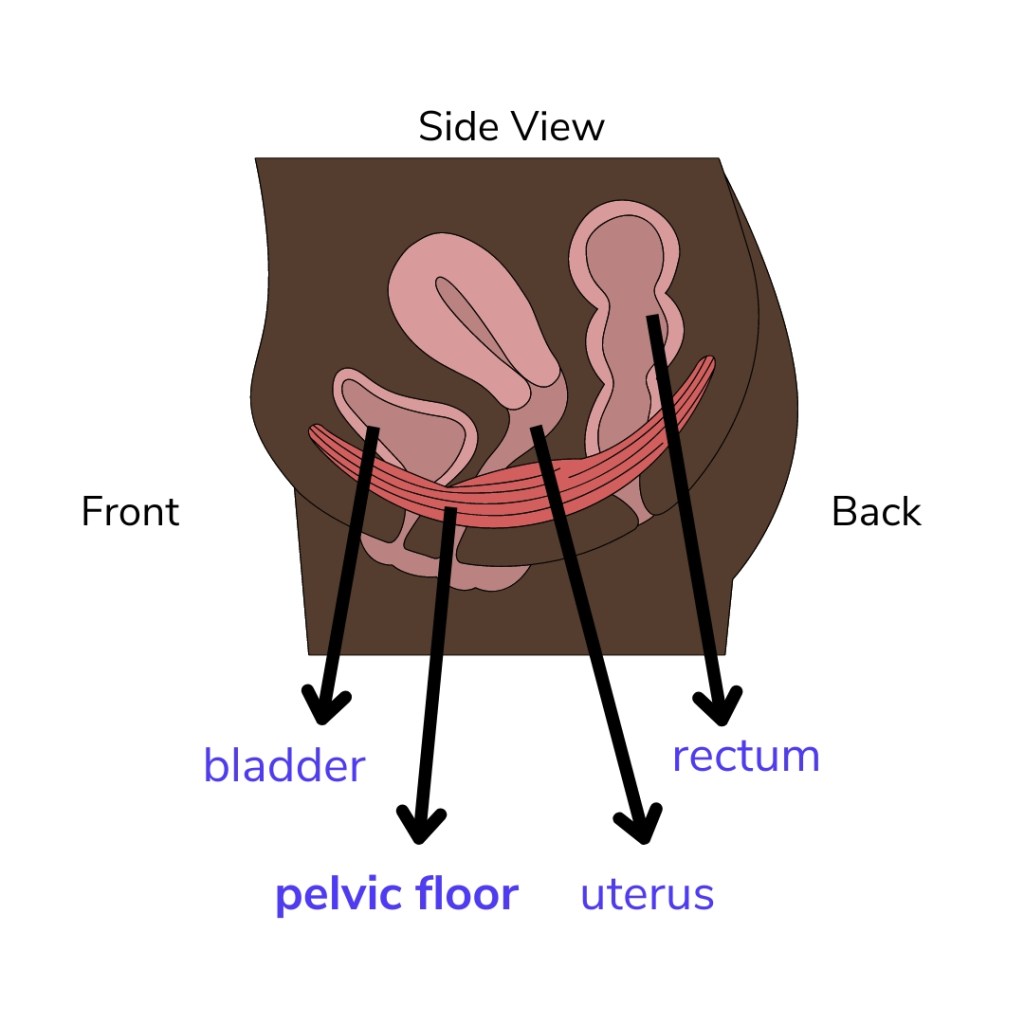
What does the Pelvic Floor Do?
The pelvic floor has four main jobs.
- To provide support for the internal organs
- To manage pressure changes inside your body
- To maintain bowel and bladder control
- To support reproductive function
Although the internal pelvic organs are suspended by their own support tissues like ligaments, they need additional support from below from the pelvic floor. Think of your pelvic floor like the bottom slice of bread on your favorite sandwich. When you pick up your sandwich, that bottom slice keeps all of your ingredients from slipping out.
This is especially important with added pressure like coughing, lifting, or pregnancy. In a typically functioning body, the pelvic floor contracts (squeezes, engages) and relaxes at the appropriate times in order to support the internal organs during such pressure changes. For instance, when you sneeze, your pelvic floor muscles should automatically engage to provide support for your internal organs as they withstand the force generated by sneezing. On average, a sneeze exerts about 90 lbs. of force!1 That’s a lot! If your pelvic floor is not able support your internal organs as it should, activities like sneezing can cause symptoms like incontinence and a sense of heaviness or bulging in the vagina.
Numerous activities increase pressure in our abdomen including coughing, laughing, jumping, and lifting, to name a few. The pelvic floor helps to manage this pressure by contracting and lifting upwards, away from your feet. In this way, your pelvic floor acts very similarly to other muscles that stabilize your body, like your deep abdominal and back muscles. For this reason, pelvic floor PTs like myself think of these muscles as part of your core.
As mentioned above, if the pelvic floor is working optimally, it prevents incontinence. Contracting the pelvic floor closes the urethral and anal openings and sends a message to your body to retain urine/stool. Usually, this contraction happens automatically to prevent leaks. In order to urinate or have a bowel movement, the pelvic floor has to completely relax.
Finally, the pelvic floor muscles are critical for optimal sexual function. They have to be relaxed to allow penetration. They also have to relax and stretch to allow a baby to exit the birth canal. They contract to produce an orgasm.
Want to learn more? Stay tuned for a pelvic floor deep dive in an upcoming post!
Rhea Physical Therapy is a mobile pelvic health clinic serving women and children in the St. Louis, MO area and beyond. Rhea PT is owned and operated by Dr. Savannah Carlson, PT, DPT, RYT. Dr. Carlson is a pelvic health specialist who is dedicated to helping her clients overcome pelvic floor dysfunction so they can reach their full potential at home, work, and play. She earned her doctor of physical therapy degree at Washington University in St. Louis.
- Adams J, Schmid J, Parker RD, Coast JR, Cheng D, Killian AD, McCray S, Strauss D, McLeroy Dejong S, Berbarie R. Comparison of force exerted on the sternum during a sneeze versus during low-, moderate-, and high-intensity bench press resistance exercise with and without the valsalva maneuver in healthy volunteers. Am J Cardiol. 2014 Mar 15;113(6):1045-8. doi: 10.1016/j.amjcard.2013.11.064. Epub 2013 Dec 25. PMID: 24440333. ↩︎
 But first, Pelvic Health.
3 responses to “What is the Pelvic Floor?”
[…] At Rhea Physical Therapy, I aim to demystify the world of pelvic floor physical therapy and provide you with the knowledge you need to take control of your pelvic health. Before we dive into the therapy itself, let’s start with the basics: What is the pelvic floor? The pelvic floor is a crucial group of muscles, ligaments, and connective tissues that form a hammock-like structure at the base of your pelvis. These structures play a pivotal role in supporting your pelvic organs, controlling bladder and bowel function, and contributing to sexual health. To get more details, check out my post about pelvic floor anatomy and physiology. […]
LikeLike
[…] Muscular Support: The pelvic floor is a group of muscles that form a supportive sling at the bottom of your pelvis. Among its many functions, this muscular structure plays a pivotal role in supporting your bladder, uterus (in women), and rectum. Imagine it as a hammock-like network of muscles, tendons, and ligaments that keeps your pelvic organs in place, preventing them from descending into the lower pelvis. You can learn more about it here. […]
LikeLike
[…] Do you leak urine when you sneeze, cough, laugh, jump, or run? This condition is called stress incontinence. All of those activities have something in common: they create physical stress in your body, whether it is through impact (running/jumping) or increased intra-abdominal pressure (coughing/sneezing). In an optimally functioning body, the pelvic floor muscles automatically engage to counteract the stress created by these activities. When this automatic action of the pelvic floor is lost or diminished, it can cause pesky leaks and other issues, like pelvic organ prolapse. Click here to review the function of pelvic floor. […]
LikeLike