
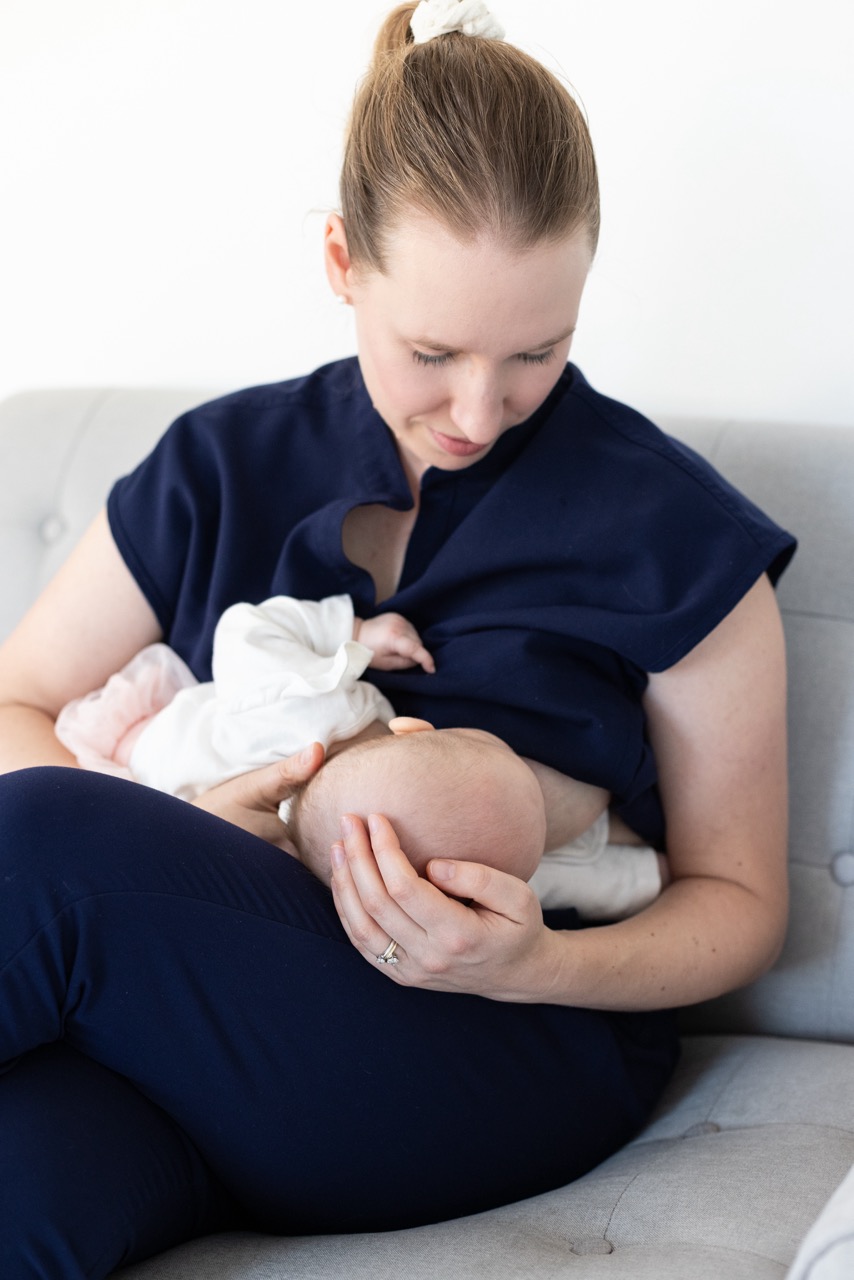
I entered my breastfeeding journey anticipating that it would come naturally. My goal was to nurse for a year. Never once did I think that would be difficult to achieve. Even though I had spoken to friends who had shared their own challenges, and even though I am a pelvic health PT specializing in pregnancy and postpartum care, I took it for granted that breastfeeding would be easy for me. So when it wasn’t, I was devastated. As I toiled away trying to improve the experience for me and my baby, I remember thinking “why didn’t anybody warn me about this?” “Why did I think this would be so simple?” That’s why I am sharing my story as part of World Breastfeeding Week. For although I am so happy I chose to breastfeed, I wish I had better understood what that choice could mean for me. All pregnant people who are considering breastfeeding deserve to have a well-rounded picture of what it may entail, the good parts and the bad. Because for many of us, it is an arduous path.
My little girl found her way to my breast soon after my OB placed her on my chest. I’m sure I helped her, but in my rosy memory, she just nuzzled her way over to my left breast and latched on seamlessly. Endorphins coursed through my body and I felt absolutely blissful. I didn’t notice that my baby’s latch was shallow, or that my nipple was quickly being rubbed raw by her little mouth. She was nursing, and that was all that mattered and all I saw.
My husband and I enjoyed two wonderful hours uninterrupted with our newborn before the pediatric team arrived to do their exam. It was then that my nurse noticed my bleeding nipples. She urged us to see the lactation consultant quickly and as many times as possible before we went home.
The next 36 hours or so were a whirlwind—emotionally, physically, and mentally. Our hospital room was a revolving door of providers, including the pediatrician, my OB, the nurses, and the lactation consultants. We saw lactation three times before we discharged. They were certainly helpful, but no matter how hard I tried to implement their guidance, each feed felt extremely challenging and riddled with uncertainty. “Am I holding my baby the right way?” “Is she getting a good latch?” “How will I know if she is swallowing?” “Why does it hurt so badly?” I was assured that my experience was normal. After all, neither me nor my baby had ever done this before! They told me both of us would get better with practice. I’d figure out what positions worked well. My baby would get better at latching. And the pain would go away.
But the pain did not go away.
For the first month, every feed came with burning pain. Sometimes it was so severe that I had to pump instead of nurse, because although that was still painful, it wasn’t as bad. Cluster feeding was especially tortuous because I never got a break from the pain. Often I cried as I nursed my little girl, bearing the pain because I felt that if I gave up and fed her formula, I would be failing her. And I did feel like a failure. I felt like my body had failed me. I felt broken. My husband did everything he could to comfort and support me. He reassured me that there was nothing wrong with feeding our baby formula. I knew logically that he was right—and we did end up supplementing—yet for some reason I felt so guilty, ashamed, and selfish.
During this period, my baby had several doctor’s appointments. We mentioned our struggles with feeding, and we even did two lactation appointments at the pediatrician’s office. Every time we took her in, they assured me that our latch was “good” and that my baby was doing well. I was so perplexed by these appointments. If everything looked “good” and my baby was healthy, then why was nursing so unbearable?
It was my postpartum doula who asked the right questions and helped me discover the source of my pain: I have Raynaud’s.
Raynaud’s Phenomenon is a condition that causes decreased blood flow to small parts of the body, typically the fingers. But it can also effect other body parts, like the nose, ears, and—you guessed it!—the nipples. This decrease in blood flow is caused by spasms in the blood vessels in response to cold or stress. I have had symptoms of Raynaud’s my entire life, but never been diagnosed. It had never created enough of a problem until I attempted to breastfeed.
I went to my OB with my suspected diagnosis. She prescribed me a topical cream that I was supposed to apply to my nipples 3 times per day (there is a pill you can take, but I wasn’t able to take it because I have low blood pressure). I followed the prescription as closely as possible, and within about a week, my pain improved. It wasn’t completely gone, but it was tolerable and only happening for about 50% of feeds. I continued nursing with renewed hope that it would get better.
Nursing did get better at that point, but only a little bit. After another month of dreading every feed, I was on the verge of giving up. Before throwing in the towel completely, I decided to see a private feeding specialist. This was definitely one of the best things I did as part of my breastfeeding journey.
Through our lactation visits, we learned that my baby had multiple ties in her mouth. She had lip ties and a tongue tie, and these were making it more difficult for her to feed. Our feeding specialist gave us a series of exercises to help with this, and as we implemented the program, we gradually began to see improvement. Around this time, the pain from my Raynaud’s significantly improved, too. By the time I was preparing to go back to work, we seemed to have figured it all out and nursing was becoming everything I was led to believe it could be—joyful, cuddly, special, and easy.
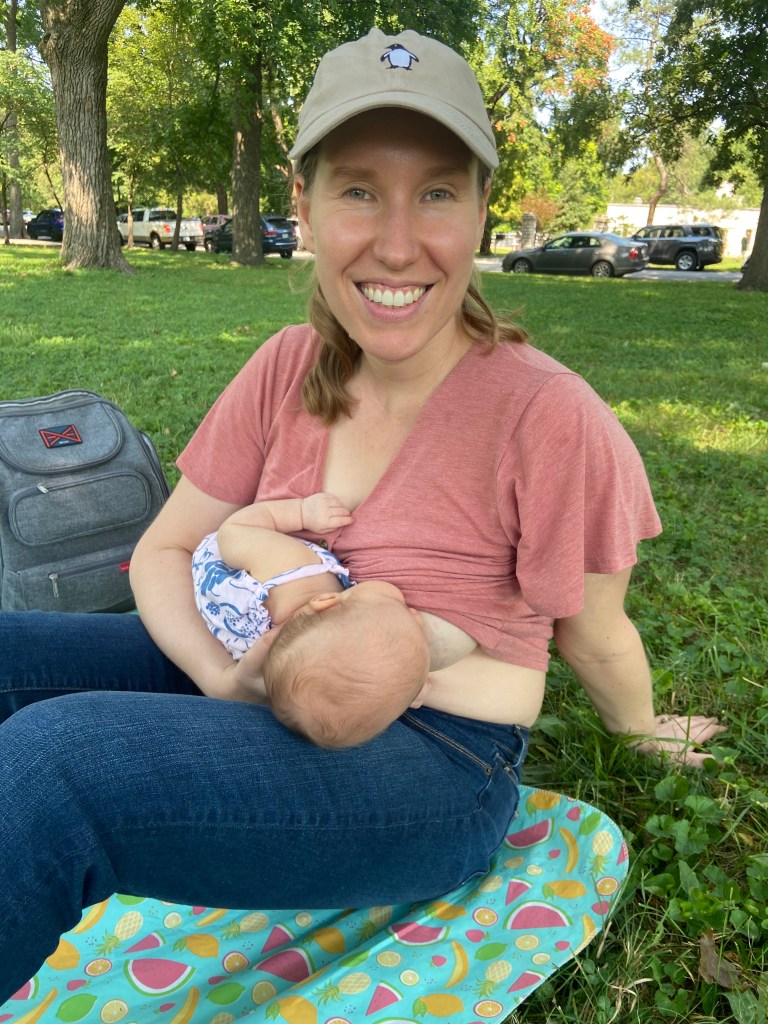
When I returned to my hospital position part time, I was confronted with a new challenge. Although my pain with nursing had gone away, I still had pain with pumping. I tried lubricants, different settings, and different flange sizes. Nothing seemed to help. I consoled myself by reminding myself that I was only working two days a week. I could tolerate anything for only two days a week…and that’s what I did.
Fast forward a year and I am slowly weaning my baby girl. We only nurse twice a day now, when she wakes up and before bed, so I don’t have to pump in the middle of the workday anymore. The pain never did go away with pumping, but I persisted anyway (for better or for worse). I made it to my goal of nursing for one year; we are now at almost 14 months. I’m not sure how much longer we will keep it up, but I won’t rush the process. We will finish breastfeeding when it is right for both of us. In the meantime, I’ll enjoy every snuggly moment I get with my baby at my breast. These moments are fleeting. And for me and countless others, they are hard-won.
 But first, Pelvic Health.