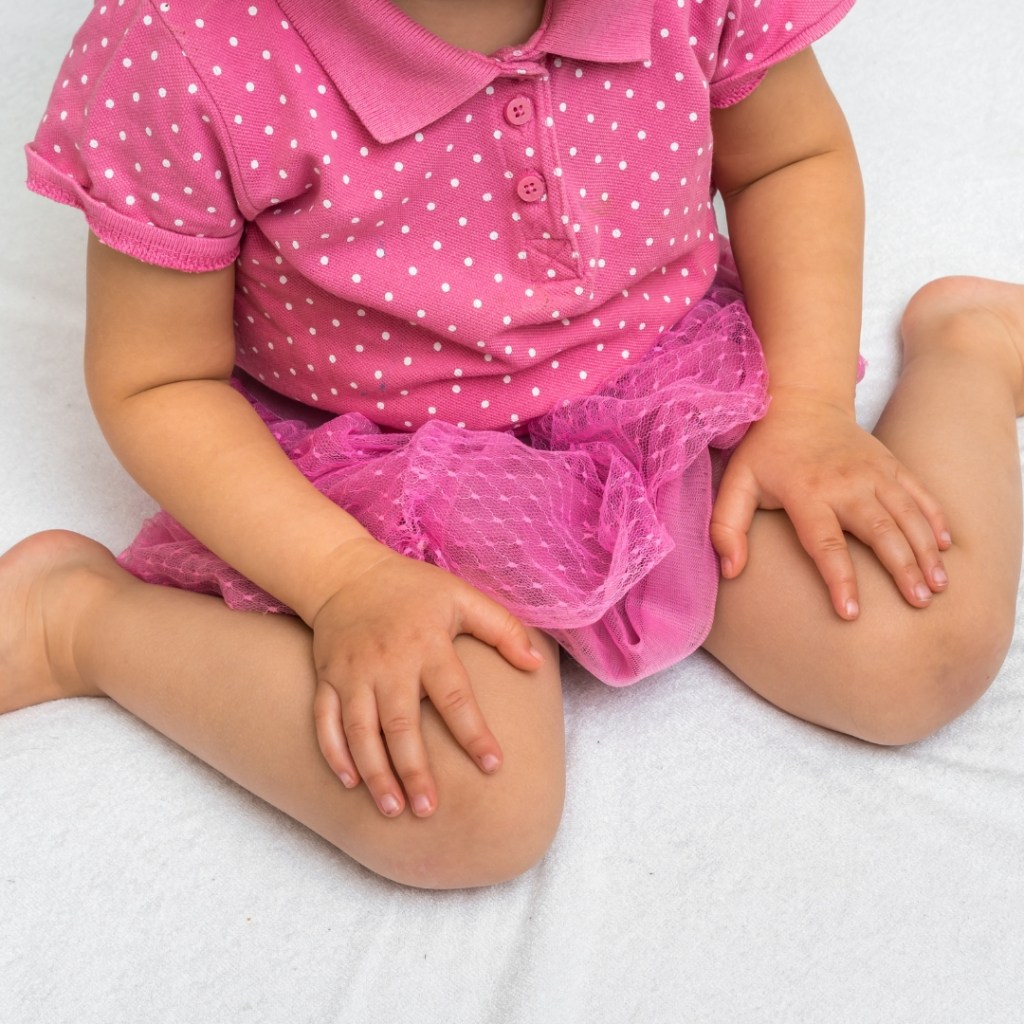
Have you ever seen a child sit with their legs bent out to the sides, bottom on the ground, and their feet pointing out or backward? This position is called “W” sitting in the therapy world, because the legs resemble the letter “W.” This is a functional posture for transitions between positions, but some children sit like this for prolonged periods of time during play. Sitting that way for a long time has the potential to negatively impact how they walk, how their bones form, and how they perform other motor skills. The position also has the potential to affect the pelvic floor.
What is going on in the body during “W” sitting?
The “W” sit requires the following joint motions:
- Internal rotation and flexion of the hip joint, meaning the thigh bone is turned in and in a sitting position
- Flexion of the knee joint, meaning the knee is bent
- Internal rotation of the tibiofemoral joint with supination of the foot and ankle OR external rotation of the tibiofemoral joint with pronation of the foot/ankle, meaning the lower leg and foot are either twisted in or twisted out (this one depends on which foot position the child prefers)
The following muscles are being stretched in the “W” sit:
- The external rotator muscles of the hip, the muscles that turn the thigh bone out
- The knee extensors, the muscles that straighten the knee
- The lower leg and ankle muscles that either rotate the foot in or out
This shape creates a wider base of support for the child in sitting, because the legs act like kick stands on each side of the torso. As a result, the muscles that create postural stability—the abdominals and back muscles—do not have to work as hard to hold the child upright.
How can this position affect the pelvic floor?
“W” sitting puts the hips in extreme internal (or medial) rotation. That means the thigh bone is turned in as much as it can be. As a result, the muscles that do the opposite motion, external (or lateral) rotation, get all stretched out and under-used. So what? Well, the hip external rotators are linked through connective tissue to the pelvic floor muscles. One specific muscle, the obturator internus, shares a fascial attachment with the pelvic floor.
Research shows that by strengthening the obturator internus, the pelvic floor muscles get stronger, too.1 This research underlies a key concept in pelvic floor muscle strengthening called overflow. The overflow strategy uses strengthening of the muscles that surround the pelvic floor, including hip external rotators like the obturator internus, to increase pelvic floor muscle strength indirectly. If the external rotator muscles are all stretched out and underused, as in “W” sitting, this could inadvertently lead to pelvic floor muscle weakness and over-flexibility due to that fascial connection. Basically, if strength can overflow into nearby muscles, weakness likely can, too.
Unfortunately, “W” sitting also has the potential to weaken the core because it provides a wider base of support. This requires less work from the muscles that keep us upright. So what? Well, the deep core and the pelvic floor muscles actually work together as a team to regulate pressure changes in our bodies. So if the core is weak, then the pelvic floor is left all alone to do the work of two muscle groups. This could cause strain on the pelvic floor and make it less effective. Then, when it’s time to hold in urine during a sneeze, a jump, or a big laugh, the pelvic floor cannot do its job. This is when accidents happen.
How do I stop my child from “W” sitting?

It’s one thing to know that prolonged “W” sitting can be harmful, but how do we prevent kids from doing it? My number one go-to strategy is to get them off the floor for play time. Encourage your child to sit in a chair, like a cube chair or other kid-sized seat. Move the toys off the floor onto a coffee table, the couch, a box, or an ottoman in front of them. This will allow them to continue to play while being in a more ergonomic position. If your child insists on playing on the floor, you can encourage them to sit with their legs crossed in front of them instead (“criss cross apple sauce”). Side sitting is another good option.
The next thing to do would be to try to figure out why your child is “W” sitting in the first place. If you believe core weakness is part of the issue, try engaging them in some fun activities that promote core strength. Playing with toys while they are in a hands and knees position and balance exercises are great places to start. Stay tuned for a post with specific ideas!
Finally, if you are concerned about your child’s core strength, pelvic floor function, or general development, I encourage you to seek the support of a pediatric physical therapist. A pediatric PT will evaluate your child’s strengths and weaknesses, then provide you with a custom exercise plan with games and activities to improve your child’s movement. If your child is struggling with pelvic floor problems, like constipation, bed-wetting, pelvic pain, or urinary incontinence, a pediatric pelvic floor PT can help. You can start by consulting your pediatrician and asking for a PT referral. Or, contact me at hello@rheaphysicaltherapy.xyz for more guidance.
Rhea Physical Therapy is a mobile pelvic health clinic serving women and children in the St. Louis, MO area and beyond. Rhea PT is owned and operated by Dr. Savannah Carlson, PT, DPT, RYT. Dr. Carlson is a pelvic health specialist who is dedicated to helping her clients overcome pelvic floor dysfunction so they can reach their full potential at home, work, and play. She earned her doctor of physical therapy degree at Washington University in St. Louis. The information provided on But First, Pelvic Health is for educational purposes only and should not be used as personalized medical advice.
- Tuttle, Lori J. PT, PhD; DeLozier, Elizabeth R. SPT; Harter, Kimberly A. SPT; Johnson, Stephanie A. SPT; Plotts, Christine N. SPT; Swartz, Jessica L. SPT. The Role of the Obturator Internus Muscle in Pelvic Floor Function. Journal of Women’s Health Physical Therapy 40(1):p 15-19, January/April 2016. | DOI: 10.1097/JWH.0000000000000043 ↩︎
 But first, Pelvic Health.